Printers Alley Nashville: History, Nightlife & Visitor Guide

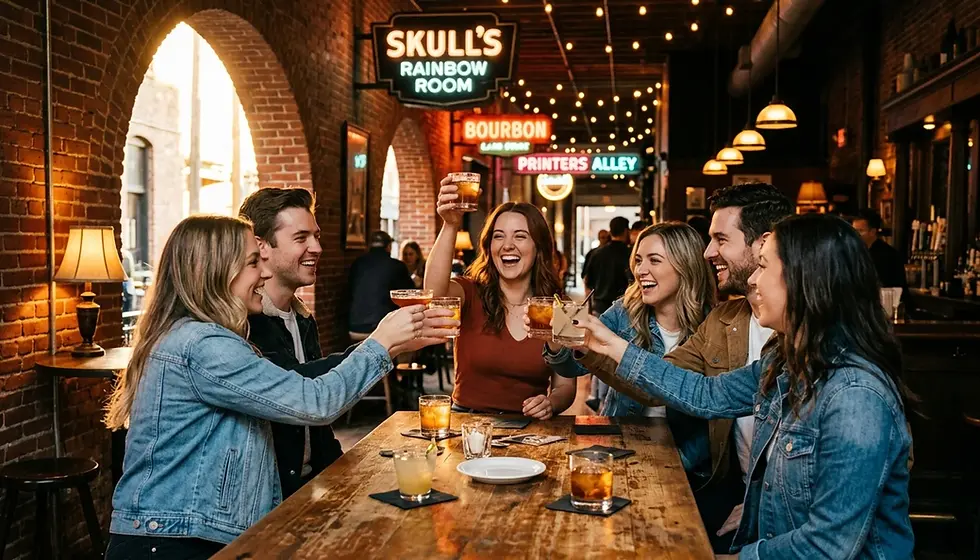
Printers Alley is a narrow, cobblestone-paved historic district in downtown Nashville, Tennessee, running between Third and Fourth Avenue North, from Union Street to Church Street. Listed on the National Register of Historic Places since 1982, it spans approximately 5 acres and packs more than 200 years of printing history, Prohibition-era speakeasy culture, live music legend, and present-day nightlife into a single city block.
Printers Alley is located between Third and Fourth Avenue North in downtown Nashville, bounded by Union Street and Church Street, and has been listed on the National Register of Historic Places since August 26, 1982 (NRHP reference No. 82003964).
The district began as Nashville's printing and publishing center around 1830, housing two major newspapers and 13 publishers by 1915, before transforming into a nightlife hub after the last print shop closed in 1977.
Prohibition came to Tennessee in 1909, four years before the national ban, and the state did not repeal it until 1937, four years after the country did: fueling decades of speakeasy culture in the alley.
Performers including Hank Williams, Jimi Hendrix, Chet Atkins, and Waylon Jennings all played in Printers Alley venues at various points in their careers.
Current nightlife highlights include Skull's Rainbow Room, Bourbon Street Blues and Boogie Bar, Alley Taps, Black Rabbit cocktail bar, and The Whiskey Shot shooting experience.
Printers Alley is roughly 8 minutes from Underwood Manor and about 8 to 9 minutes from The Herman Haven, both of which make practical home bases for a night out in the district.
What Is Printers Alley in Nashville Known For?
Printers Alley is known for three distinct legacies: its 19th-century role as Nashville's printing and publishing capital, its Prohibition-era reputation as the city's most notorious speakeasy corridor, and its present identity as a concentrated strip of bars, live music clubs, and historic hotels in the heart of downtown. No other block in Nashville layers that much history onto cobblestones.
The alley sits roughly two blocks north of Broadway's honky-tonk strip, but the two districts feel very different. Broadway is loud, wide, and tourist-forward. Printers Alley is narrow and older, with Italianate, Queen Anne, and Romanesque building facades that date to the late 1800s. You are more likely to find a blues act or a jazz set here than a cover band cranking out country radio hits.
The land itself has an unusual origin. Virginia businessman George Michael Deadrick gifted it to the city of Nashville in the 1780s, well before Nashville became a state capital. By 1830, printing operations had clustered here organically, drawn by the central location and proximity to government offices. By 1915, the block housed The Tennessean, The Nashville Banner, 10 print shops, and 13 publishers. The last of them, Ambrose Printing Company, finally left in 1977.
What filled the gap was entertainment. Specifically, the kind of entertainment that required dimly lit rooms, jazz records, and a willingness to look the other way. According to Randy Fox's definitive Nashville Scene piece on the alley's speakeasy era, the combination of political protection and genuine demand made Printers Alley one of the most reliably lawless blocks in the South for decades.

How Did Printers Alley Become a Nightlife District?
Printers Alley's transformation from publishing hub to entertainment district happened gradually across the late 19th and early 20th centuries, accelerating dramatically during Prohibition. By the late 1800s, the corridor had already earned the nickname "the Men's Quarter," housing hotels, gambling halls, saloons, and brothels alongside the print shops. The printing trade and the vice trade coexisted for decades before the latter fully took over.
Tennessee enacted its own statewide Prohibition in 1909, four years before the national Volstead Act. According to the Tennessee State Library and Archives exhibit on Prohibition repeal, the state also held out until 1937 before lifting the ban, a full four years after the national repeal in 1933. During those 28 years, Printers Alley establishments simply continued serving alcohol under cover, protected by politicians and police who were reportedly well compensated for their amnesia. The common legal fiction was that customers had "brown bagged" their own liquor, which the establishment then opened for them.
Even after 1937, Tennessee law prohibited selling alcohol by the glass. This produced what locals called "mixer bars," where patrons brought their own bottles and paid only for the mix. The system persisted until 1968, when Nashville finally legalized full alcohol sales. Counterintuitively, full legalization actually hurt the alley. The mystique of the semi-illicit club had been a core part of its appeal.
The 1940s represented the peak of the alley's underworld glamour. Gangsters including Jimmy Washer, James "Slow" Barnes, Bob Carny, and David "Skull" Schulman operated venues that mixed fine dining, burlesque, and live music. Notable rooms from that era included The Captain's Table, The Brass Rail Stables, The Embers, The Black Poodle Lounge, and the Voo Doo Lounge. Burlesque performers Dixie Evans, Shannon Doah, and Kitten Natividad were regulars. For a fuller visual sense of the alley during this period, the Nashville Public Library's 1958 photograph of Printers Alley is a striking primary document.
What Famous Musicians Played Printers Alley?
Printers Alley is one of the few places in Nashville where performers at every career stage, from unknowns to legends, shared the same stages over the same decades. The alley's clubs were particularly important in the 1940s through 1970s as launching pads, side gigs, and after-hours spots for Nashville's recording industry, which was consolidating on nearby Music Row during that same period.
The documented list of performers is remarkable: Chet Atkins, Floyd Cramer, Hank Garland, Jimi Hendrix, Boots Randolph, Jeannie Seely, The Supremes, Ernie Terrell, Mel Tillis, Dottie West, Hank Williams, Waylon Jennings, Denise Darcel, and Barbara Mandrell all performed in the alley's venues. The range alone tells you something: a gospel-country legend like Hank Williams and a guitar pioneer like Jimi Hendrix appearing in the same corridor speaks to how genuinely central this block was to Nashville's music ecosystem.
Paul McCartney gave the alley perhaps its most unexpected cultural shoutout. His 1974 song "Sally G.," released as the B-side of the Paul McCartney and Wings single "Junior's Farm," specifically mentions Printers Alley by name, cementing the district's place in recorded popular music history.
If you want to trace Nashville's broader live music geography, the Nashville Live Music Venues Guide covering 15 local favorites beyond Broadway provides helpful context for how Printers Alley fits into the city's larger scene in 2026.
Is Printers Alley Worth It? A Practical Assessment
Printers Alley is worth visiting, but with realistic expectations. It is not a full-night destination on its own. Think of it as a complement to a broader downtown evening rather than the anchor of one. The district has genuine character, real history, and several excellent bars and venues. It also has variable crowd density depending on the night and can feel quieter than you might expect compared to the constant energy two blocks south on Broadway.
The honest case for going: the alley offers a noticeably different atmosphere than Broadway. Crowds are smaller, the music leans toward blues and jazz rather than bro-country covers, and the historic building stock gives the whole corridor a texture that Nashville's newer entertainment districts lack. On a Friday or Saturday night, Bourbon Street Blues and Boogie Bar typically runs two blues acts, and the energy inside is genuinely good.
The honest case for tempered expectations: on a weeknight, especially early in the evening, the alley can be sparse. Some venues have cover charges that may not feel justified if the act isn't strong. The cobblestone surface is uneven and genuinely difficult to navigate in heels after midnight, a detail that matters more than guides usually admit. Accessibility for visitors using wheelchairs or mobility aids is limited due to the historic pavement.
Best approach for 2026 visitors: arrive between 8 and 9 PM on a weekend, eat dinner nearby first, then treat the alley as a two-to-three hour bar crawl before or after hitting Broadway. The combination plays to both districts' strengths.

What Is the Story Behind Skull's Rainbow Room?
Skull's Rainbow Room, located at 222 Printers Alley, is the single venue most identified with the district's mythology. Founded in 1948 by David "Skull" Schulman, it began as a striptease club and evolved through jazz, blues, burlesque, country, and rock phases over five decades. The Nashville Scene's coverage of the venue's history describes Schulman as a complex figure who turned a speakeasy-era club into one of Nashville's most enduring entertainment institutions.
The story ends violently. In 1998, shortly before the venue was scheduled to open for the evening, two robbers murdered Schulman inside the club. The Rainbow Room closed but was later revived. Today it operates as a supper club featuring burlesque performances, jazz, and craft cocktails in a setting that deliberately honors its mid-century origins. The interior leans into velvet, low lighting, and a theatrical quality that distinguishes it sharply from the more casual bars nearby.
The ghost angle is real enough to take seriously as a tourism draw. Regular visitors and staff have reported unexplained sounds and cold spots, and the story of Skull's murder has enough dramatic specificity to sustain the legend. If you are interested in Nashville's paranormal tourism circuit, the Rainbow Room is consistently the most compelling stop in the downtown core. Whether or not you believe the ghost is present, the building's actual history is strange enough to be unsettling on its own terms.
Reservation recommended, especially on weekends. The dinner and show format means walk-in availability can be limited after 8 PM.
What Bars and Nightlife Venues Are Currently in Printers Alley?
Printers Alley's current nightlife venues range from a century-old blues bar to a laser-gun shooting experience, which gives you a sense of how eclectic the strip has become. The Nashville Downtown Partnership's official Printers Alley page keeps a current directory, but here is a practical breakdown of what to expect from each major venue as of 2026.
Skull's Rainbow Room (222 Printers Alley)
The alley's signature destination. Burlesque shows, jazz acts, craft cocktails, and a supper club format that requires more commitment than a standard bar visit. Dress accordingly: casual is fine but the crowd trends toward smart casual on show nights. Cover charges vary by performance. Arrive early if you want a table.
Bourbon Street Blues and Boogie Bar (220 Printers Alley)
Live music seven nights a week in a Mardi Gras-themed setting, typically featuring two blues acts per night. This is the most reliably active live music venue in the alley and the best choice if a spontaneous night of blues is the goal. No advance planning required, just show up.
Alley Taps (162 Printers Alley)
Also live music seven nights a week, with sets starting at 6 PM every evening. Traditional bar food, draft beer, and wine. The earlier start time makes Alley Taps a good first stop if you are building an itinerary from dinner onward.
Black Rabbit
A craft cocktail bar operating out of a building that dates to the 1890s, which previously served as the law office of Frank Ragano, legal counsel to Jimmy Hoffa. The history is genuinely interesting and the staff knows it. Order a bourbon-forward cocktail and ask about the building if the bar is not too busy.
The Whiskey Shot
A bar combined with an ultra-realistic shooting experience using laser-based guns that fire harmless invisible beams. Currently open Friday and Saturday nights. It is exactly as fun as it sounds for groups who want something interactive before or after the bar circuit.
Dirty Little Secret
Part of Dream Nashville, this Las Vegas-style nightclub features DJ performances and a high-energy dance floor. Open Friday and Saturday nights. Higher energy and louder than the rest of the alley, skewing younger. If the rest of the strip feels too quiet for your group, this is the volume adjustment.
Lonnie's Western Room (308 Church St.)
Technically on Church Street at the alley's edge, Lonnie's has operated since 1989 and is one of Nashville's most respected karaoke destinations. The institutional knowledge behind the song catalog is real. Go on a Tuesday or Wednesday if you want a shorter wait for your song.
Fleet Street Pub
An English-style pub in a basement setting with 14 beers on draught. Everything edible, including the sauces, sausages, batters, and fries, is made in-house. One of the most underrated spots in the alley for anyone who wants a quieter drink and genuinely good pub food rather than another loud venue.
Where Should You Eat Near Printers Alley?
Dining options within and immediately adjacent to Printers Alley range from a World War II memorabilia-themed family restaurant to a James Beard-adjacent hotel dining room, so the category covers a lot of ground. Plan your meal before arriving in the alley at night, because the most interesting dinner options require a reservation or at least a table strategy.
Gray and Dudley (21c Museum Hotel, 221 2nd Ave. N.)
Named for the building's previous life as the Gray and Dudley Hardware Company, the restaurant at 21c Museum Hotel is one of the more distinctive dining rooms near the alley. The contemporary American menu sits inside a hotel that doubles as a functioning art museum, with rotating large-scale installations throughout the common areas.
417 Union (417 Union St.)
A family-owned restaurant with World War II memorabilia on the first floor and Civil War artifacts on the second. The dual-floor museum element is unusual and genuinely engaging if you arrive early enough to look around before the dinner crowd fills in.
Daddy's Dogs
The Printers Alley location of Daddy's Dogs opened in 2021. The brand started as a street cart in 2015, opened a flagship in The Nations neighborhood in 2017, and has built a genuine local following. Creative hot dog variations and a relaxed format make it a good option for groups who want something casual and fast before the evening begins.
The Stillery (113 2nd Ave. N.)
Known for creative mason jar cocktails and brick-fired pizza, with a covered outdoor patio that works well in moderate weather. The mason jar presentation is a reliable Instagram moment if your group wants one. Best visited before 9 PM on weekends to avoid the longest waits.
Back Alley Diner (217 Arcade Alley)
Features live music on Saturdays and singer-songwriter nights during the week. A diner format with entertainment makes it an efficient use of an evening for groups who want food and music without the full supper-club commitment of Skull's Rainbow Room.
Dunn Brothers Coffee (401 Church St.)
Worth noting for morning visits. Dunn Brothers hand-crafts coffees brewed in small batches rather than pulling from a single commercial espresso pump. If you are doing a daytime history walk of the alley, this is the right place to start.
What Are the Hotels Near Printers Alley?
Several hotels operate within or immediately adjacent to the Printers Alley Historic District, ranging from 130-room boutiques to larger design hotels with multiple dining and nightlife options on site. The proximity advantage is real: being within a two-minute walk of the alley changes how you plan an evening significantly.
Bobby Hotel
A boutique property with 144 rooms, located in Printers Alley itself. Approximately a 6-minute walk from the Ryman Auditorium. The rooftop features seasonal installations and is one of the better downtown rooftop spots for a pre-dinner drink. The hotel's design aesthetic leans toward mid-century modern, which pairs well with the alley's vintage character.
Hotel Indigo
Opened in 2010 in a converted bank building with 130 rooms and a printer-themed lobby that pays direct homage to the alley's history. A 3-star property that sits at the junction of accessibility and character. The lobby details, including printing-press motifs and archival typography, are worth 10 minutes even if you are not staying.
Dream Nashville
Set in two historic landmarked buildings with 168 art deco-inspired rooms, six dining and nightlife options including Dirty Little Secret nightclub, and 8,000 square feet of event space. The most self-contained of the Printers Alley hotels: you could theoretically spend an entire evening without leaving the property.
Noelle
With 224 rooms, Noelle has one of the more interesting histories: it originally opened in 1929 as the Noel Hotel, spent decades as an office building, and was converted back into a boutique hotel under the Noelle name in 2017. The building's bones from 1929 are visible in the high ceilings, detailed plasterwork, and lobby proportions.

Practical Visitor Tips: When to Go, How to Get There, What to Expect
Visiting Printers Alley rewards planning more than Broadway does. The strip is shorter, the venue formats vary more widely, and the best experiences require showing up at the right time with a rough sequence in mind. Here is what most guides skip.
Best Time to Visit
Friday and Saturday evenings between 8 and 11 PM deliver the most consistent energy across venues. Weeknight visits, especially Sunday through Wednesday, can be genuinely quiet. If you prefer a lower-key experience or want to actually hold a conversation at a bar, Tuesday through Thursday evenings are worth considering. Daytime visits for architecture and history are best on weekdays, when foot traffic is low.
Getting There and Parking
Printers Alley is located at the geographic center of downtown Nashville, roughly between 3rd and 4th Ave. N. Rideshare is the most practical option for groups arriving from properties outside the immediate downtown core. From Underwood Manor, for example, the alley is roughly an 8-minute drive. From The Herman Haven, plan on a similar 8 to 9 minute trip. Parking garages on 4th Ave. N. and Church Street serve the district; street parking is available but limited on evenings.
Cover Charges
Most live music venues in the alley charge a cover, typically ranging from $5 to $15 depending on the night and the act. Skull's Rainbow Room charges more for full dinner and show packages. Fleet Street Pub and Black Rabbit do not typically charge a cover. Budget an extra $20 to $30 per person for covers if you plan to visit two or three venues in a single night.
Dress Code
No venue in the alley enforces a strict dress code, but Skull's Rainbow Room and the upscale cocktail bars attract a smarter casual crowd. Dirty Little Secret skews toward club attire on Friday and Saturday nights. The cobblestone surface is the more practical concern: flat shoes are a genuinely better choice than heels, particularly late in the evening when the uneven pavement becomes harder to navigate.
Accessibility
The historic cobblestone pavement is the primary accessibility barrier. Wheelchair access and mobility aid navigation is genuinely difficult through most of the alley proper. Several venues are accessible once you reach the entrance, but the approach from the street requires careful navigation. If mobility is a consideration, arriving by rideshare to the closest drop-off point and contacting venues in advance to ask about interior accessibility is the most reliable approach.
Age Restrictions
Most venues in the alley enforce a 21-plus policy after approximately 9 PM, particularly on weekends. Daytime and early evening visits are more flexible for those under 21, but the district's primary draw, which is its nightlife, is adult-oriented by design. Confirm directly with individual venues if age requirements matter for your group.
A Suggested Itinerary
Start at Dunn Brothers Coffee at 401 Church St. in the afternoon if you are doing a history walk. For an evening, begin with dinner at 417 Union or The Stillery around 6:30 PM. Move to Alley Taps at 162 Printers Alley by 8 PM when the live music is in full swing. From there, walk to Skull's Rainbow Room at 222 Printers Alley for the show and craft cocktails. Cap the night with a drink at Black Rabbit before deciding whether to extend into Broadway's honky-tonk corridor, which is an easy two-block walk south. Total active time: three to four hours.
Groups planning a broader Nashville itinerary around this kind of evening will find Stay Nashville's Nashville Attractions and Things to Do guide useful for building out the surrounding days.
Where Do Most Celebrities Hang Out in Nashville?
Celebrity sightings in Nashville concentrate most heavily in a band of neighborhoods running from the Gulch through SoBro into 12 South and East Nashville, with Printers Alley and the broader downtown core featuring most prominently during major industry events. The short answer for 2026: there is no single address that guarantees celebrity encounters, but certain contexts make them far more likely.
The Ryman Auditorium's event schedule is the most reliable signal. After-show gatherings following Ryman performances historically cluster in bars within walking distance, which puts Printers Alley adjacent venues and lower Broadway in play on those nights. The same logic applies to Bridgestone Arena events and to Nashville's festival calendar, particularly during CMA Fest in June.
Printers Alley specifically attracts musicians and industry figures who prefer a slightly lower-profile setting than Broadway's neon-lit chaos. The smaller venues, the jazz and blues format, and the historic atmosphere make it a natural fit for off-duty performers. Skull's Rainbow Room has maintained industry connections since its founding in 1948 and remains a known destination for Nashville music figures specifically.
For visitors staying in the downtown core, the Luxe Loft SoBro 916 sits three blocks from Broadway and within a short walk of the Ryman Auditorium, positioning guests in the middle of the most active celebrity-sighting geography in Nashville.
How Does Printers Alley Compare to Lower Broadway?
Printers Alley and Lower Broadway are two different propositions, and choosing between them, or deciding how to combine them, should be a conscious decision rather than an afterthought. Broadway is the city's loudest, most concentrated, most tourist-saturated entertainment corridor. Printers Alley is narrower, quieter, older, and considerably more eclectic.
Factor | Printers Alley | Lower Broadway |
Music Format | Blues, jazz, burlesque, DJ nights | Predominantly country and cover bands |
Crowd Size | Smaller, more variable by night | Consistently dense Thursday through Sunday |
Historic Character | Italianate and Romanesque buildings from the 1890s | Mix of historic and modern construction |
Noise Level | Lower, conversation is possible | Very high, especially indoors |
Cover Charges | Typically $5 to $15 per venue | Mostly free entry, tips expected for bands |
Accessibility | Cobblestone surface, limited | Paved sidewalks, more accessible |
Walking Distance Between | Approximately 2 blocks north of Broadway |
The practical recommendation: treat both as a single extended evening rather than an either-or choice. Start in Printers Alley at 8 PM while the energy is building, then walk south to Broadway around 10 or 11 PM when Broadway's peak crowd energy matches the late-night moment. Groups doing a Nashville bachelorette trip should note that the bachelorette planning guide from Stay Nashville covers the timing and logistics of this exact combination in detail.
What Is the National Register Designation for Printers Alley?
The Printers Alley Historic District is an official listing on the National Register of Historic Places, added on August 26, 1982, under NRHP reference number 82003964. The designation covers approximately 5 acres and recognizes the district's architectural significance, including buildings constructed in Italianate, Queen Anne, and Romanesque Revival styles, as well as its historical importance as Nashville's primary printing and publishing center during the 19th and early 20th centuries.
The National Park Service's official NRHP record for the Printers Alley Historic District is the primary source for the designation details. The listing also notes that Printers Alley was the site of Nashville's first parking garage and its first skyscraper, two distinctions that have not survived into the modern streetscape but confirm the alley's outsized role in the city's urban development history.
The NRHP designation does not restrict commercial activity but does provide access to historic preservation tax credits for qualifying renovation projects. Several of the district's buildings, including those now occupied by Bobby Hotel and Hotel Indigo, have benefited from historic rehabilitation frameworks that preserved exterior architectural details while updating interiors for contemporary hospitality use.
Frequently Asked Questions About Printers Alley Nashville
What are the best bars in Printers Alley Nashville right now?
The strongest options in 2026 are Skull's Rainbow Room for a full dinner and burlesque show experience, Bourbon Street Blues and Boogie Bar for consistent live blues seven nights a week, and Black Rabbit for craft cocktails in a historically significant building. Fleet Street Pub is the best choice for quieter conversation and genuinely good pub food with 14 beers on draught. For groups wanting something interactive, The Whiskey Shot operates Friday and Saturday nights.
How far is Printers Alley from Broadway Nashville?
Printers Alley is approximately two blocks north of Lower Broadway, between Third and Fourth Avenue North. The walk from the heart of Broadway's honky-tonk strip to Printers Alley takes roughly 5 to 7 minutes on foot. The two districts are close enough to combine into a single evening without any transportation between them.
Is Printers Alley safe?
Printers Alley is an active, staffed entertainment district in the center of downtown Nashville, which makes it generally safe during evening hours when venues are open and foot traffic is present. As with any urban entertainment district, standard precautions apply: stay within the lit and populated areas, use rideshare for late-night returns to your accommodation rather than walking long distances, and keep your group together. Daytime visits are unremarkable in terms of any safety concern.
Can you walk to Printers Alley from downtown Nashville hotels?
Yes. Printers Alley is within walking distance of most downtown Nashville hotels, typically a 5 to 15 minute walk depending on your starting point. The Ryman Auditorium is about 6 minutes away on foot. Bobby Hotel is located directly in the alley. Visitors staying at properties like the Luxe Loft SoBro 916 or the Luxe Cowgirl 538, both three blocks from Broadway, can reach the alley in under 10 minutes on foot.
Is Printers Alley good for a bachelorette party?
Printers Alley works well as one component of a Nashville bachelorette evening, particularly if the group enjoys live music, historic atmosphere, and a mix of venue types. It is not a substitute for Broadway but pairs extremely well with it. Start the evening in the alley around 8 PM, hit Skull's Rainbow Room for the show, then walk to Broadway for the late-night honky-tonk portion. Many bachelorette groups also base themselves at group-friendly rentals like Underwood Manor or The Herman Haven, both about 8 minutes from the alley.
What is the ghost story associated with Printers Alley?
The most documented paranormal connection involves Skull's Rainbow Room at 222 Printers Alley. Owner David "Skull" Schulman was murdered by two robbers in 1998 shortly before his club was scheduled to open for the evening. Following his death, staff and visitors began reporting unexplained sounds and atmospheric disturbances inside the building. The ghost of Skull Schulman is a recurring element of Nashville's paranormal tourism circuit, and the Rainbow Room leans into the legend with the same enthusiasm it applies to its burlesque and jazz programming.
Does Printers Alley have live music every night?
Yes. Both Bourbon Street Blues and Boogie Bar and Alley Taps offer live music seven nights a week. Bourbon Street Blues typically runs two blues acts per night, while Alley Taps starts music at 6 PM daily. Skull's Rainbow Room features scheduled burlesque and jazz shows on specific nights, which vary by season. Back Alley Diner runs singer-songwriter nights and live music on Saturdays. The combined schedule means some form of live performance is reliably available any night of the week.
Where should I stay to be close to Printers Alley in Nashville?
For a downtown walking-distance option, Bobby Hotel is inside the alley itself and Hotel Indigo is steps away. For groups that prefer a full vacation rental experience, Underwood Manor is approximately 8 minutes away by car and offers a speakeasy-themed game room, 7-person hot tub, and accommodations for up to 10 guests. The Herman Haven is similarly close at around 8 to 9 minutes. Both provide the group amenities and space that hotel rooms cannot match for larger parties, with easy rideshare access to the alley.
Plan Your Printers Alley Visit: Final Recommendations
Printers Alley Nashville is one of the city's most historically layered destinations, and in 2026 it remains genuinely worth visiting for anyone who wants a different texture than Broadway delivers. The district runs roughly 200 yards of cobblestone between Third and Fourth Avenue North, packing a National Register Historic District, a ghost story, a blues bar that runs seven nights a week, one of Nashville's most theatrical supper clubs, and a building that once housed Jimmy Hoffa's lawyer into a space you can walk end to end in three minutes.
Go on a Friday or Saturday evening, arrive by 8 PM to secure a table at Skull's Rainbow Room or Bourbon Street Blues, budget $20 to $30 per person for covers, wear flat shoes on the cobblestones, and plan to finish the night on Broadway two blocks south. That sequence gives you the best of both districts in a single evening without rushing either.
Davidson County welcomed 16.9 million visitors in 2026 and generated a record $11.2 billion in visitor spending, according to the Nashville Convention and Visitors Corp. The appetite for authentic Nashville experiences has only grown since. Printers Alley, with its 200-year arc from land grant to speakeasy to national historic district, is one of the few places in the city where that history is physically present and still entertaining at midnight.

If you are building an evening around Printers Alley, Underwood Manor is the most thematically fitting home base in the Stay Nashville portfolio. The rustic modern farmhouse features its own speakeasy-style game room with an 8-foot pool table, darts, and a whiskey barrel bar, original hardwood floors and exposed wooden beams, and a 7-person hot tub in the private backyard for the post-alley wind-down. It sleeps up to 10 guests and sits roughly 8 minutes from the alley by car. Check availability at Underwood Manor before your Nashville dates fill the calendar.


Comments