How to Get Around Nashville Without Renting a Car


Getting around Nashville without a car is genuinely practical in 2026, especially if you are staying close to the Broadway corridor where the free Music City Circuit runs every 10-15 minutes.
WeGo Public Transit operates 27 local bus routes and 9 regional routes, with all-day unlimited passes at $4 per person, according to Visit Music City.
Rideshare (Uber and Lyft) is the most flexible option for groups, with typical fares from properties near Midtown to Broadway running $7-15 depending on time of day.
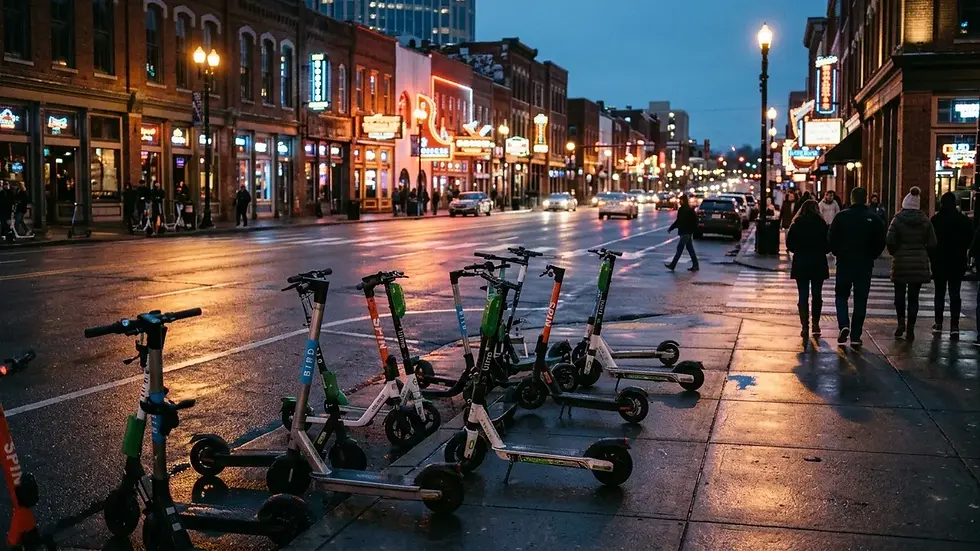
BCycle Nashville operates roughly 30 stations downtown for bike-share, while Bird, Lime, and Lyft scooters cover downtown and Midtown for short trips.
Bus route 18 connects Nashville International Airport (BNA) to downtown from approximately 5:30 a.m. to midnight on weekdays, with a $2 standard fare.
Nashville welcomed 16.8 million visitors in 2023, a record high per WPLN News, and projections put that figure at 17.8 million by 2026, making transit planning smarter than ever.
Nashville's tourism boom changes the ground-level experience every year. According to WPLN News, visitor spending reached $10.56 billion in 2023 and is projected to hit $11.4 billion by 2026. More visitors means more rideshare drivers, more scooters on the street, and more congestion if you are in a car. Knowing how to get around Nashville without one puts you ahead of the gridlock.
At Stay Nashville, we field questions about transportation from every group that books with us. The honest answer is that your transit strategy depends on three things: where you are staying, how large your group is, and what time of night you plan to head home. This guide breaks down each option so you can plan with confidence.
Is Nashville Easy to Get Around Without a Car?
Nashville is easy to get around without a car if you are staying in or near downtown. The Broadway corridor, SoBro, The Gulch, and Germantown are all well-served by rideshare, free shuttles, bikes, and scooters. Neighborhoods farther out, like 12 South, East Nashville, and Music Row, require a short Uber or Lyft ride but are still straightforward to navigate car-free.
The core walkable zone covers roughly a 1-mile radius around Lower Broadway. Within that zone, you can reach the Ryman Auditorium, Bridgestone Arena, the Country Music Hall of Fame, the Cumberland River Greenway, and dozens of bars and restaurants on foot. No app required. The Gulch sits about a 10-15 minute walk southwest of Broadway, and Germantown is roughly 15 minutes north on foot if the weather cooperates.
Beyond that core, you are looking at rideshare. And the good news is that Nashville's rideshare coverage is dense. According to data from FOX 17 News, Nashville has approximately 9,300 active short-term rentals and attracted record tourism through 2023 and 2026, which means Uber and Lyft driver supply in the city has grown proportionally. Wait times under five minutes are typical during daytime hours in most central neighborhoods.
The one honest caveat: late Saturday nights on Lower Broadway are a different story. Between midnight and 2 a.m. on peak nights, surge pricing can push a short Uber ride to $30-40. More on that in the after-midnight section below.
What Is the Best Way to Travel Around Nashville?
The best way to travel around Nashville for most visitors is a combination of rideshare for longer distances and walking or scooters for short downtown hops. Rideshare via Uber or Lyft covers the entire metro area reliably, requires no transit card or schedule knowledge, and scales easily for groups. For a party of 4-10 staying near Midtown, a typical Uber to Broadway costs $7-15 on a weekday evening.
Here is how the main options stack up at a glance:
Mode | Best For | Typical Cost | Coverage Area | Available After Midnight? |
Rideshare (Uber / Lyft) | Groups, late nights, any distance | $7-40 depending on time and demand | Metro-wide | Yes, but surge pricing applies |
WeGo Bus | Budget travel, airport, daytime | $2 per ride / $4 all-day pass | 27 local routes | No (most routes end by midnight) |
Music City Circuit (free) | Downtown sightseeing and hops | Free | Downtown corridor only | No |
BCycle / bike-share | Short daytime rides, Midtown, Gulch | Varies by membership / hourly rental | ~30 downtown stations | Limited |
Scooters (Bird / Lime) | Short trips, last-mile connections | Typically $1 unlock + per-minute fee | Downtown and Midtown | Yes, with app |
Pedicab | Short Broadway-area hops | Negotiated, typically $5-20 | Broadway and Midtown only | Yes on weekends |
Taxi | Airport runs, no-app travelers | Metered or flat rate | Metro-wide | Yes |
Walking | Lower Broadway, SoBro, short hops | Free | 1-mile downtown radius | Yes (well-lit areas only) |
For groups of 6 or more, rideshare is almost always the right call. Splitting a $15 Uber five ways is $3 per person, which is cheaper than a WeGo round-trip for some routes. The Music City Circuit is the sleeper pick: genuinely free, frequent, and underused by most out-of-towners.

How Does the WeGo Bus System Work, and Is It Worth Using?
WeGo Public Transit is Nashville's Metropolitan Transit Authority, operating 27 local bus routes and 9 regional routes across Davidson County. A single ride costs $2, and an all-day unlimited pass is $4, making it the most affordable way to travel around Nashville for solo travelers or pairs on a budget. You can buy passes through the WeGo QuickTicket app or at WeGo Central, the main downtown hub located next to the Municipal Auditorium.
For most vacationers, the realistic use cases for WeGo are: the airport run (bus route 18), reaching the Grand Ole Opry area (bus route 34), and connecting Vanderbilt and Music Row to downtown (bus routes 64 and 93 on weekdays). For spontaneous bar-hopping after 9 p.m., WeGo is not the right tool. Bus frequency drops significantly in the evening and most routes end service between 10 p.m. and midnight.
The official WeGo website has live maps and schedules. The WeGo QuickTicket app lets you load and reload passes digitally. Both are worth bookmarking before your trip.
Bus Route Schedules at a Glance
Route | Key Destinations | Weekday Service Window | Weekend Service |
Route 18 | BNA Airport to downtown | ~5:30 a.m. to midnight | ~7 a.m. to 11 p.m. |
Route 34 | Downtown to Grand Ole Opry / Opry Mills | ~6:30 a.m. to 10 p.m. | Daily service |
Routes 64 and 93 | Vanderbilt to Broadway / Country Music Hall of Fame / Ryman | ~6:30 a.m. to 5:30 p.m. | No weekend / holiday service |
Route 9 | Metro Center and downtown loop | Weekday daytime | Limited |
A practical note on routes 64 and 93: they are useful if your rental is near Vanderbilt University and you want to reach Broadway without paying for a ride, but they run on weekday daytime hours only. Plan accordingly. For real-time departures, check WeGo's Maps and Schedules page before heading to the stop.
Is There a Free Shuttle in Nashville?
Yes. The WeGo Music City Circuit is a free bus service operating three routes through the downtown corridor, running every 10-15 minutes. The Circuit connects major attractions including the Ryman Auditorium, the Tennessee State Museum, Bicentennial Capitol Mall, the Farmers Market, and the waterfront. It is the single most underrated transit tool in Nashville, and most first-time visitors have no idea it exists.
WeGo Central, the main hub for all WeGo services, sits adjacent to the Municipal Auditorium in downtown Nashville. From there, the Circuit branches in three directions through the core. No fare, no app, no card. You simply board and ride.
The Music City Circuit runs during daytime and early evening hours. It is not a late-night option. But for getting between the Tennessee State Museum, the Farmers Market, and the riverfront without burning $20 on Ubers, it does the job better than any alternative.
Separately, sightseeing operators like Old Town Trolley and Gray Line Tennessee offer hop-on, hop-off tours around Nashville landmarks. These are paid options (not free), but they double as practical transportation if you plan to visit multiple attractions on the same day. Music City Safari operates a similar narrated trolley tour departing from 2nd and Broadway at the Hard Rock Cafe. If you want context about what you are passing, the tour format earns its price. If you just need a ride between museums, take the free Circuit instead.
How Do Scooters, Bikes, and Pedicabs Fit Into the Picture?
Scooters, bike-share, and pedicabs are ideal for short last-mile connections within downtown Nashville and Midtown. Bird, Lime, and Lyft scooters are app-based and widely available throughout the Broadway area and Midtown. Typical cost is around $1 to unlock plus a per-minute fee. A 10-minute scooter ride costs roughly $3-5, making it competitive with WeGo for very short distances and far more flexible on timing.
BCycle Nashville operates approximately 30 bike-share stations downtown, with bikes available for hourly rental or multi-day memberships. Nashville GreenBikes supplements BCycle in some areas. For visitors who want to cycle the Cumberland River Greenway or explore the Gulch on two wheels, the BCycle network is the right starting point. Check the BCycle Nashville app for station locations and real-time availability.
Pedicabs are a legitimate option for very short hops along Broadway and in Midtown, particularly between venues on a Friday or Saturday night. You flag them down on the street, negotiate a fare (typically $5-20 for short distances), and they pedal you a few blocks. They are slower than scooters and weather-dependent, but they add no surge pricing and require no app. Worth using for a 3-block jump when the sidewalks are crowded.
One honest note on scooters: many Nashville visitors grab one and immediately realize they have no idea where to park it legally. Look for designated scooter parking corrals, which are marked at most major intersections downtown. Leaving one in a random spot can result in an app fee and sometimes a city fine. The Lime and Bird apps both show approved parking zones on their maps.
How Do You Get From BNA Airport to Downtown Nashville Without a Rental Car?
Getting from Nashville International Airport (BNA) to downtown Nashville without a rental car means choosing between bus route 18, rideshare (Uber or Lyft), a traditional taxi, or a shared shuttle service. Bus route 18 is the cheapest option at $2, running from BNA to downtown roughly from 5:30 a.m. to midnight on weekdays and 7 a.m. to 11 p.m. on weekends. The ride takes 30-45 minutes depending on traffic.
Airport Transport Cost and Time Comparison
Option | Typical Cost (per trip) | Travel Time | Best For | Availability |
WeGo Bus Route 18 | $2 | 30-45 min | Solo travelers, budget trips | Weekdays 5:30 a.m.-midnight; weekends 7 a.m.-11 p.m. |
Uber / Lyft (standard) | $25-40 (non-surge) | 18-25 min | Groups, late arrivals, convenience | 24/7 (surge pricing applies late nights) |
Taxi (Yellow Cab, Music City Cab, Magic Taxi, NashVegas Cab) | Metered rate, roughly comparable to rideshare | 18-25 min | No-app travelers, flat-rate zones | 24/7 (available at taxi stands at BNA) |
For a group of 4-6 guests arriving together, rideshare is the clear winner on cost-per-head. BNA to downtown in a standard Uber runs $25-40 non-surge, split across 4 people that is $7-10 each, roughly the same price as four bus tickets and far faster with luggage. The Luxe Cowgirl 538, for reference, sits about 8.2 miles from BNA, approximately a 15-minute Uber ride.
Taxi companies serving Nashville include Magic Taxi, Music City Cab, NashVegas Cab, and Yellow Cab, as noted by the Visit Music City Transportation page. Taxis queue at the designated ground transportation area at BNA. For the airport ride specifically, some groups prefer a taxi because the fare is fixed or metered without the surge variable. Either option gets you downtown in similar time.
One thing most guides skip: if you arrive during a major event weekend, surge pricing on rideshare can spike sharply. CMA Fest in June, the Rock n Roll Marathon in April, and FIFA Club World Cup matches (scheduled for Nashville in 2026) all create compressed demand windows. For those weekends, the $2 Route 18 bus looks considerably more attractive.
What Happens After Midnight When Buses Stop Running?
After midnight in Nashville, your realistic options for getting around are rideshare (Uber or Lyft with surge pricing factored in), traditional taxis, pedicabs on Lower Broadway, and scooters where they are still available. WeGo buses and the Music City Circuit both stop service before or around midnight, so public transit is not a factor for late-night returns from Broadway.
This is the part of the transportation conversation that most Nashville travel guides gloss over, and it is the part that actually matters for group trips. Here is what you need to know:
Surge pricing is real and predictable. Between 12:30 a.m. and 2 a.m. on Friday and Saturday nights, Uber and Lyft surge consistently around Lower Broadway. A ride that cost $12 at 11 p.m. can cost $35-45 at 1:30 a.m. The fix is simple: pre-schedule your Lyft return for a time slightly before or after the worst of it, or hail from a side street rather than the Broadway curb. Korean Veterans Boulevard and Rosa L Parks Avenue (8th Ave) see shorter waits and lower surge multipliers than the Broadway strip itself.
Pedicabs thin out after 1:30 a.m. They work well for 10-11 p.m. Broadway hops, but by 2 a.m. the supply drops. Do not count on one for the last ride home.
Scooters have geofenced no-ride zones. Some Bird and Lime scooters are locked out of certain downtown areas during late-night hours. Check the app before committing to a scooter as your last-mile plan after midnight.
The best late-night strategy for groups: Walk one block off Broadway before requesting a ride. Pick a fixed meeting point (a specific cross street, not "outside Tootsie's") and agree on it before anyone's phone dies. Pre-book for groups of 6 or more using the Uber or Lyft scheduled ride feature, which locks in the estimated price before surge.
Which Transit Mode Works Best in Each Nashville Neighborhood?
Transit practicality in Nashville varies significantly by neighborhood. The right mode for Lower Broadway is different from the right mode for 12 South, and knowing the difference saves money and frustration. Specifically, neighborhoods within a mile of downtown support walking and scooters, while neighborhoods like 12 South and East Nashville are best reached by rideshare from most rental home locations.
Neighborhood-by-Neighborhood Transit Guide
Neighborhood | Distance from Broadway | Best Transit Mode | Notes |
Lower Broadway / SoBro | On-site | Walking, scooters | Most venues walkable; Music City Circuit covers the corridor |
The Gulch | 0.5-1 mile | Walking (from SoBro), scooters, Uber | 10-15 min walk from Broadway; BCycle stations available |
Midtown / Music Row | 1.5-2.5 miles | Uber, WeGo routes 64/93 (weekdays) | $8-12 Uber from Broadway; bus runs weekday daytime only |
Germantown | 1.2-1.8 miles | Walking (fit visitors), Uber | Mostly flat, 20-30 min walk; Uber ~$8-10 |
East Nashville | 2-3 miles | Uber / Lyft | No direct bus connection to Broadway; Uber $10-18 |
12 South | 3-4 miles | Uber / Lyft | $12-20 Uber; not a walking destination from downtown |
Centennial Park / Vanderbilt | 2-3 miles | WeGo routes 64/93 (weekday), Uber | Herman Haven guests: Centennial Park is 1.3 miles from the property |
Grand Ole Opry / Opryland | 9-12 miles | WeGo Route 34 or Uber | Bus takes 35-50 min; Uber ~$22-35 |
A useful detail for guests at The Herman Haven: the property sits 1.3 miles from Centennial Park and 2.3 miles from Broadway. That distance is best covered by Uber ($8-12 each way), which keeps things simple for a group of 10. Guests at the Luxe Cowgirl 538, on the other hand, are 4 minutes from Broadway on foot. The transit math for those two properties is completely different, and it should factor into which one you book.

Does Staying Close to Broadway Make a Difference?
Staying close to Broadway makes a substantial difference in how easy it is to get around Nashville without a car. Properties within walking distance eliminate the rideshare dependency entirely for evening outings, which also eliminates late-night surge pricing and the group-coordination logistics of calling multiple cars. The tradeoff is that walkable-to-Broadway properties typically offer less outdoor space and fewer group amenities than houses a few miles out.
At Stay Nashville, we manage both types deliberately, because different groups need different things. The Luxe Loft SoBro 916 is 3 blocks from Broadway, a 10-minute walk to the Ryman Auditorium and steps from Bridgestone Arena. For a couple or a group of 4 who plans to spend every evening on Lower Broadway, that walkability is worth everything. You roll out the door, walk to Tootsie's or Legends Corner, and walk back. No app, no surge, no waiting.
For a bachelorette group of 10 who wants a private hot tub, a speakeasy game room, a fire pit backyard, and a serious pregame before hitting Broadway, the right call is Underwood Manor, which sits 2.1 miles from Broadway. The ride is $9-13 each way for the group. Over a 3-night stay with 2 Broadway nights, that's maybe $50-80 total in transportation. For what the property delivers, that's a reasonable tradeoff that most bachelorette groups are happy to make.
For groups scaling up to 16-24, the Ultimate Bach Pad, a compound of two side-by-side luxury duplex homes, sits 8-10 minutes from Broadway by rideshare, typically a $7-10 Uber per car. With a driveway that fits 8 cars and street parking available, larger groups can also consider carpooling in personal vehicles if some guests are driving in. The rooftop decks, dual hot tubs, and three game rooms mean the property itself handles a significant portion of the group's entertainment needs before anyone steps outside.
You can explore the full range of Nashville properties and check which neighborhoods best fit your group's plans at Stay Nashville's Nashville Vacation Homes page. If you want help planning the logistics for a specific group size, our blog covers Nashville neighborhoods, bachelorette planning, and transportation in detail.
Frequently Asked Questions
Is Nashville easy to get around without a car?
Yes. Nashville is straightforward to navigate without a car, particularly if you are staying downtown or in SoBro. Rideshare (Uber and Lyft) covers the entire metro area reliably, the free Music City Circuit shuttle handles the downtown corridor, and scooters and bikes work well for short hops. Neighborhoods like 12 South and East Nashville require a 10-15 minute Uber ride, but never require a rental car.
What is the best way to travel around Nashville?
The best overall option is rideshare combined with walking for shorter distances. Uber and Lyft provide metro-wide coverage with typical downtown fares of $7-20, scaling well for groups. For budget-conscious solo travelers, WeGo's $4 all-day pass and the free Music City Circuit are excellent complements. Scooters (Bird, Lime) add useful flexibility for last-mile connections under a mile.
Is there a free shuttle in Nashville?
Yes. The WeGo Music City Circuit operates three free bus routes through downtown Nashville, running every 10-15 minutes. The Circuit connects the riverfront, Bicentennial Capitol Mall, the Tennessee State Museum, the Farmers Market, and the main Broadway area. It runs during daytime and early evening hours. Old Town Trolley and Gray Line Tennessee offer paid hop-on, hop-off sightseeing tours as a separate alternative.
What is the 3-foot rule in Nashville?
The 3-foot rule in Nashville refers to Tennessee's state law requiring drivers to maintain at least 3 feet of clearance when passing cyclists on the road. This rule is relevant for visitors who rent BCycle bikes or scooters and ride in mixed traffic. It does not restrict where cyclists can ride, but it shapes how drivers are expected to behave around them. Stick to designated bike lanes where available.
How do I get from BNA airport to downtown Nashville without renting a car?
WeGo bus route 18 runs from Nashville International Airport (BNA) to downtown for $2, operating roughly 5:30 a.m. to midnight on weekdays. The ride takes 30-45 minutes. Rideshare (Uber or Lyft) is the faster option at $25-40, taking 18-25 minutes depending on traffic. Taxis from companies like Yellow Cab, Magic Taxi, NashVegas Cab, and Music City Cab are available at BNA's taxi stand with metered fares.
What is the cheapest way to get around Nashville?
The cheapest way to get around Nashville is the free Music City Circuit shuttle within downtown, followed by WeGo bus service at $2 per ride or $4 for an all-day unlimited pass. BCycle bike-share is also low-cost for short distances. For groups, rideshare cost-per-person often beats bus fares for routes where multiple people split the fare on a direct trip.
Are there rideshare surges in Nashville I should plan around?
Yes. Rideshare surge pricing on Uber and Lyft is consistent between midnight and 2 a.m. on Friday and Saturday nights near Lower Broadway. A standard $12-15 Uber can spike to $35-45 during peak departure windows. The practical fix: pre-schedule a Lyft return for 11:30 p.m. before the rush, or request from a side street (Korean Veterans Boulevard or Rosa L Parks Avenue) rather than the Broadway curb where wait times and multipliers are highest.
Can I get to the Grand Ole Opry without a car?
Yes. WeGo bus route 34 runs from downtown Nashville to the Grand Ole Opry and Opry Mills area daily, from approximately 6:30 a.m. to 10 p.m. The ride takes roughly 35-50 minutes. Rideshare is faster at 20-30 minutes and typically costs $22-35 depending on time of day. Check showtimes at the Grand Ole Opry official website and plan your return before 10 p.m. if using Route 34.
Ready to Explore Nashville on Your Own Terms?
Getting around Nashville without a car comes down to one practical formula: use the free Music City Circuit for downtown hops, Uber or Lyft for everything else, and scooters when you need a spontaneous 5-minute jump across the Gulch. Nashville's rideshare coverage is strong, the transit options are better than most visitors expect, and the city's core attractions are dense enough that walking handles more than you think.
Where you stay shapes how much all of this costs and how smoothly it works. A property 3 blocks from Broadway means almost no transportation spend on evening outings. A house 2 miles out with a hot tub, game room, and fire pit means a few short Uber rides that the group splits anyway. Both are valid. The right choice depends entirely on what your group values most.
Nashville welcomed a record 16.8 million visitors in 2023 according to WPLN News, and visitor projections for 2026 reach 17.8 million. That growth means more transit options, more rideshare drivers, and more scooters on the street, making car-free travel in Music City more practical than ever as you plan your trip this year.

If your group wants a property close enough to Broadway to keep rideshare costs minimal but spacious enough to make the rental itself a destination, the Ultimate Bach Pad delivers exactly that combination. Two side-by-side duplex homes with dual rooftop skyline views sit 8-10 minutes from Broadway by Uber, with a driveway that fits 8 cars if any guests are driving in from out of town. Check availability for your dates here.
Written by Chase Gillmore, Owner & Operator at Stay Nashville


Comments